FEATURED PROJECTS is a platform to present and share our newsletter and socially engaged projects among members and non-members alike. The goal is to provide a resource of art projects from various locations focusing on a variety of mediums, topics, issues, and audiences. If you have any questions or would like to submit please contact us HERE. In your submission, please include: your project title, with a bried one line description of who you are working with; include up to 5 images + short image descriptions (10-40 words), and a brief project description ( up to 250 words) and website/contact information.
TO READ: Please click on titles to open the articles. Thanks.
NOVEMBER 2024: Thinking together about “Learning Together: Art Education and Community” at Gallery 400
Column Guest Written by Lucero Aguirre, Amy Chen, Sarah Gorman, and Amelia Lozada
The Community Arts Caucus invited four art educators to reflect on the exhibition “Learning Together: Art Education and Community” at Gallery 400 in Chicago. Amelia Lozada teaches 5th-8th grade IB Art at Little Village Academy in Chicago. Amy Chen teaches K-8th grade at Nathan Davis Elementary in Chicago. Sarah Gorman teaches PK-8th grade at Jane A. Neil Elementary in Chicago. Lucero Aguirre is a PhD student in Art Education at University of Illinois, Urbana-Champaign. Amy, Sarah, and Amelia developed individual lesson plans as part of a downloadable toolkit for the exhibition.

[image description: In the center a large photo shows part of the 17 x 100-foot Orr Academy High School mural. To the right, photos show documentation related to the process of making the mural. To the left is a metal student desk with paper sheets curling up and out of its surface.]
Amy: Walking through the gallery and seeing the history of art education in Chicago makes me reflect on what my impact will be like for my community. The specific piece in the exhibit that came to mind were the sneakers students made at Monica Haslip’s Little Black Pearl in collaboration with a shoe company. It was very inspirational to see the products students created, and it made me want to create opportunities for my students to experience how their art can have an impact. I am restarting an art program at a school without art in over 5 years and am constantly thinking about how making art relevant to my student’s cultures and neighborhoods can create meaning. My first year of teaching has been challenging, but going through the gallery and seeing the significance community art programs have on students’ lives makes me reflect on my responsibility to students and their communities.
Sarah: I walked into the opening, slightly nervous. When I got to the last gallery room, a large group was gathered in a conversation. I quickly realized that this group of people had never met before, but most of them were art teachers in Chicago. As they talked, names of people nearly everyone knew and places they had all been kept popping up. This conversation has encouraged me to reflect on the community I want for myself and my colleagues. My first year of teaching has been challenging and genuinely would not be possible without my support system of art teachers, UIC teachers, teachers from when I was in school, and many artists who have taught me throughout life. I wrote a lesson plan for Olivia Gude’s work and the spiral curriculum. Gudes’ work, like this exhibition, highlights the importance of community in whatever stage of life you may be in, and those communities are ones we have to build for each other.
Amelia: Archiving our communities can help us document significant changes and activate critical thinking skills when looking into archives. Archives can be activated by students and interpreted in different ways that give them different perspectives. Often, this allows them to learn about stories long forgotten or express ideas about any changes that may be happening in their communities. For example, the “Archiving Our Communities” lesson plan showcases how you can utilize archives to make a new work of art that brings meaning to something as simple as a Google Maps street view tool. This exhibition is a way of positively highlighting the impact of community art-making and the importance of art education in every neighborhood. Archives feed into the possibilities of the art we can make, helping students and teachers create art that tells stories we often don’t hear.
Lucero reflects on a panel discussion: Gallery 400 had a memorable energy and a warm excitement awaiting the start of the panel discussion. I learned of influential teaching redefining Chicago’s spaces of art education, each speaker tracing these lineages into their present classrooms and organizations. The panelists seemed to have a thread connecting them to a mentor, one another, or their work as educators in Chicago. These artist-educators spoke to their present undertakings, bringing up challenging questions and reflective experiences that shaped their journeys up until that moment. At one point, the panel focused on balancing art making and teaching. These educators were finding ways to redefine and resist constraints made by strict definitions of practice every day, maybe without realizing. This point during the panel brought assurance to both panelists and the guests listening.
AUGUST 2024: We are going to Kentucky
by Jennifer Bergmark, Carina Maye, Tim Abel, William Estrada, and Angela Baldus

Caption: “Shared Heritage” by Liz Richter was painted during the Smoketown Mural Festival in 2019, supported by Fund For the Arts in conjunction with the long-term Image Mural Festival, Imagine Greater Louisville PRoject and Louisville Metro Government. The mural of two blue hands sewing the binding onto a brightly patterned and colored quilt is tucked into the space where an apartment building and a single story home meet.
The Community Arts Caucus will initiate a new annual award for a community arts organization or project in the host city of the national conference. We are very excited to learn more about amazing community arts initiatives and share their work here, at the national convention, and in future publications. The co-directors of the CAC are looking at community arts in Louisville and are sharing a few organizations that stand out in our initial research.
To kick this off, we want to highlight IDEAS xLab, a community arts organization that is focused on supporting community projects and culturally responsive initiatives that project hope through the arts. The projects engage the community in transformative experiences that address health, justice, and community narratives. One project that is featured prominently on their website is the (Un)Known Project, an arts-based public history project founded in 2020 by Hannah Draket and Josh Miller. This project honors names and stories of enslaved Black people through art installations and experiences. This public art project has shared over 800 names and stories to promote learning, reconciliation, and respect. The collective community effort to combine narratives, installations, and experiences is a powerful way to create deeper understandings of the history of enslavement in Kentucky and the United States.
Next, we encourage you to consider Kentucky Refugee Ministries, Inc. (KRM), a non-profit community organization that provides support and services to migrants and refugees in Lousiville and Lexington, Kentucky. While KRM’s mission statement focuses on self-sufficiency, integration, and inclusion, its arts programming caught our attention. Take a look for yourself! Their project “Art Makes Home,” which was on view at various locations from 2020-2022. KRM hosts free events for families and strives to highlight the ever-growing diversity in Louisville. In addition to arts programming, KRM works with local immigrant-owned coffee shops to host what they call ‘Language Cafes,’ offers tutoring and support for families, helps people navigate the healthcare system, and even offers fitness classes for elders. Their work truly seems to understand the expansive ways art is integrated with living. We are excited to keep an eye on the calendar and see what they are up to this coming spring.
Last, we bring forth Fund for the Arts (FFTA). This 75-year-old regional non-profit invests in local artists and fellow art organizations to ensure the arts continue to thrive across Greater Louisville communities. In addition to supporting local arts organizations, FFTA provides access to creative events and programming for children and young adults ages 0-21 years old with its Cultural Pass. This pass allows the youth free access to 50 arts locals during the summer months. Beyond its breadth reach across Louisville, it provides ongoing updates on events and programming that engage various audiences. Its local and national legacy includes being one of the two oldest United Art Funds in the country. Local residents of Louisville can visit the FFTA website to receive instruction on funding opportunities and deadlines for Art event planning opportunities and grants for artists, educators, and organizations.
While we did not cover them here, we also are keeping our eyes on the Louisville Visual Arts, Art Sanctuary, Side by Side, Root Cause Research Center, Kentucky Foundation for Women, and YouthBuild Louisville. However, we want to hear more from our members and supporters. Who else should we consider as we look into Arts Organizations shaping the visual arts and culture of Louisville, Kentucky? Whether you live in Louisville or know about the great work coming out of the city, your perspective matters. Reach out and let us know!
Contact us at communityartcaucus@gmail.com or The Community Arts Caucus Facebook Group. Please visit our website to stay updated with all that is happening with CAC. We would also love to hear from you if you have any suggestions regarding our newly established annual regional award to support community arts projects or practitioners in the region.
MAY 2024: If you missed us, We missed you!
By Tim Abel, Carina Maye, Jennifer Bergmark, William Estrada, Angela Baldus
Many of us look forward to attending the NAEA Convention as a time to reconnect and make new connections. Attending sessions, our annual business meeting, and a trip to Springboard for the Arts inspired us to direct our efforts towards connecting to and amplifying community arts practitioners and programs that are doing amazing work. If we missed you, hopefully this quick summary will inspire you to connect with us soon.

[Image Caption: Community Art Caucus visits Springboard for the Arts in St.Paul Minnesota]
Our trip to Springboard for the Arts was exactly what we hoped to experience when visiting a community centered hub dedicated to supporting artists and the local communities they live and work in. We graciously followed associate director Jun-Li Wang around Springboard’s beautifully and thoughtfully designed St. Paul building. The structure was once a car dealership and still bears elements from its original purpose – for example the large shop sign is now an artists’ work invitingly framed in the sky and the garage doors open from community hall into the front yard, both are used for events and performances. There is a rooftop for gatherings, a community resources hub, a chill room, open office space for staff, shared studio space, and many, many artists installations which have been carefully incorporated into the buildings’ form and function. It is spectacular in appearances, and as Jun-Li repeatedly made evident, the space is also supremely committed to the local community and artists – ingenuity is channeled into generative exchange.
Something that was clear after our visit to Springboard was that as an organization, they are focused on how to support locally engaged projects that dive deep into building long-term relationships and are searching for sustainable solutions to issues. They also know that this isn’t work that only takes place just in the Twin Cities, so among the many creative tool kits found on their Creative Exchange online platform, they added the Creative Change Coalition in November of 2023. The Creative Exchange is a place to connect to stories and resources related to creative placemaking across the nation and in their words: “projects that bring people together.” The Creative Change Coalition goes further to create a care web of support and connections that ranges from monetary to technical to conversational.

[Image Caption: Community Arts Caucus members and Travel Award Recipient at the 2024 NAEA Convention Town Hall ]
We were excited to meet and present the CAC Travel Award to Elvia Rodriguez Ochoa. Elvia has worked as a community artist in the Chicagoland Area for the last 30 years, with extensive experience in performance, screenprinting, and arts administration. She recently founded and is the Executive Director of Chicago Community Art Studio. Their mission is to support local artists and communities’ general well-being by providing arts programs for all ages, backgrounds, and experiences focusing on trauma-informed practices. Chicago Community Arts Studio supports equitable pay for artists and access to the arts for the general public in accessible locations. Their vision includes children participating in arts activities that foster self-confidence, parents engaging in arts activities that reduce stress, and elders participating in arts programs to help maintain brain health while providing opportunities to share their knowledge with the younger generations through holistic approaches that foster community building and cultural sustenance.
As members and supporters, you can visit our website to stay updated with all that is happening with CAC. Our website adorns our newly designed logo, created by Co-Directors Tim Abel and Angela Baldus. As you navigate our website, you will also find our updated Constitution and Bylaws and our recent NAEA articles. This year, to help build our Caucus for the future, we established an Advisory Committee, which consists of Cielo Aguilera (new member), Neil Flynn (new member), and Paulina Camacho Valencia (Past Co-Director). We are dedicated to building a caucus that is relevant and responsive. In addition to our annual travel award, we established a regional award to support Community Arts Projects or Practitioners in the region, hosting our annual NAEA convention. There will be more information to come, so keep an eye out.
How Can We Engage You? Is it via Instagram, Facebook, X, or a newsletter? We want to reach you. Contact us at communityartcaucus@gmail.com or The Community Arts Caucus Facebook Group.
MARCH 2024: Twin Cities: Community Arts
Introduction by Tim Abel; Column Guest Written by Ellen Mueller
We are looking forward to the convention in April and are excited to share that we will be doing a site visit with the Springboard for the Arts after our town hall meeting on Friday afternoon, April 5th, 2024. Directions and public transportation options will be discussed at the meeting. Springboard for the Arts is an independent non-profit that has a long history of supporting artists and the arts communities out of their St. Paul and Fergus Falls offices. We will meet at 5:30pm at their St. Paul offices (262 University Ave West Saint Paul, MN 55103). Hope to see everyone there!

[Image Description: photo from the Springboard for the Arts website, showing the newly renovated St. Paul offices. A crab apple tree in full-bloom partially fills the left side of the photograph. The words: “ST. PAUL” and “Springboard for the arts” are in white over the center of the image.]
As a way to help us further spotlight the community arts in the Twin Cities, we invited Ellen Mueller to share her perspective about community arts and the Twin Cities. Ellen Mueller is an interdisciplinary artist with a socially-engaged practice that explores issues related to the environment and capitalism, utilizing a variety of media. She has exhibited nationally and internationally. She is currently also the Director of Programs at Arts Midwest. Arts Midwest is one of six regional non-profits set up through partnerships between state agencies and the National Endowment for the Arts in the 1970s to advocate, connect and celebrate the creative communities of each specific region and beyond.

Title: Walker, walking bridge, basilica
Photo Credit: Ellen Mueller
[Image Description: Cars and people navigate a complicated intersection on a bright fall day. An artist-designed yellow and blue pedestrian bridge spans the road to the left. The skyline stretches off to the right, behind the trees of Loring Park.]
The community-based arts scene in the Twin Cities is incredibly fluid and interdisciplinary. I see practitioners working across a spectrum from fully independent to fully institutionally-sponsored initiatives. Some events and projects are one-off and temporary, while others are years long, and every variation in between.
Impressive efforts include “The Landing Strip” in Minneapolis, which is on the more independent end of the spectrum. It is a self-described community garden and social hub led by Lyn Corelle on an empty lot, and they host events including clothing swaps, pot-lucks, zine festivals, weekly fires, community meals, and musical performances, among many others. I’ve screened a short experimental film there as part of one of their evenings, “Little Stabs at Happiness,” and they’ve collected a great community there.
Then there’s the artist-run “Weird Stuff Only,” self-described as a celebration for the weirdo artists making strange time-based media, and hosted by Merit Thursday at Bryant Lake Bowl & Theater. This community-based event series is slightly more formal, as it occurs inside a theater, and is one of many events scheduled there. They welcome filmmakers, projection artists, puppeteers and experimental artists, who come together to create a very unique community-based atmosphere every other week. I see a lot of ongoing enthusiasm for this series, as it fills an important undefinable niche in the scene. This event series is also a stalwart advocate for masking, creating a space that is welcoming to our disabled community members.
Another notable effort is Public Functionary, an artist-led endeavor to dream and live in a world where their multi-faceted identities are celebrated and centered; a place where creative production is reparative and generous. They are housed in a variety of spaces throughout the Northrup King building, cultivating BIPOC and marginalized artists’ presence and growth to build diverse communities of practice. They regularly host conversations, exhibitions, installations, screenings, and even a recent two-day celebration of BIPOC nerds featuring workshops, a cosplay contest, a gaming area, dance party, and more. Everything about this multi-faceted project is community informed and engaged. Members of the leadership team are long-time residents of the neighborhood, with deep connections to this community.
And finally, on the fully-institutional end of the spectrum, there are events like “Meet at Mia: Open Studios,” a monthly occurrence that encourages community gathering and centers artist-led activities. All of these efforts, and everything in between, help to create a vibrant scene that supports artists as they grow community-based practices in the Twin Cities.
JUNE 2020: A School Community Created through Traditional Ekete Basketry
By Che Sabalja
Art and Art Education, EdD Program, Teachers College, Columbia University/ Art Teacher, Montessori 31, Yonkers Public Schools
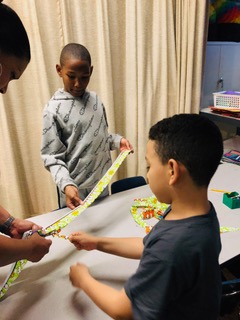
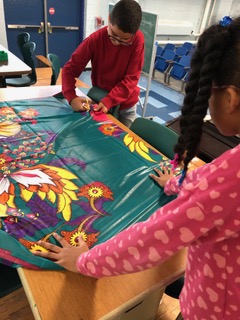


The complexity of social concerns which are not addressed in the school environment can be welcomed by the artistic process that incorporates self-reflection and discourse in visual arts education. Students may heighten social awareness to foster change within their community through personal narrative as a vital aspect of defining and taking ownership of their identity and sense of place.
The project used verbal and visual context focused on Effective Empathetic Learning
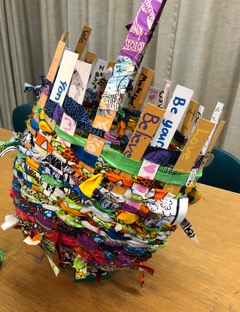
strategies to develop community. Guest artist, Ugo-Charles Onyewuchi, incorporated indigenous arts as a socio-cultural document in contemporary society to promote exchange and commonalities inspired by Ekete basket weaving. The community project led by an artist of color introducing non-western art forms facilitated a tangible learning opportunity for students from predominantly immigrant families.
The project provided value and respect for art forms and cultural expression other than European derived and one in which the students identified with and were invested. The artistic exchange of multimodal narratives including musical playlists, choice of fabrics, reflective writing on stems, and collage, encompassed the students’ shared stories, histories, and journeys interweaving the school culture with the Yonkers community and beyond borders to Africa. By working as a holistic entity facilitated by narrative embedded within the baskets, students shared sense of community and discovered connections with each other in a contemporary setting.
OCTOBER 2019: Community Arts Caucus Column for NAEA News Fall 2019
Written by Eunji Lee, CAC President 2019-2020
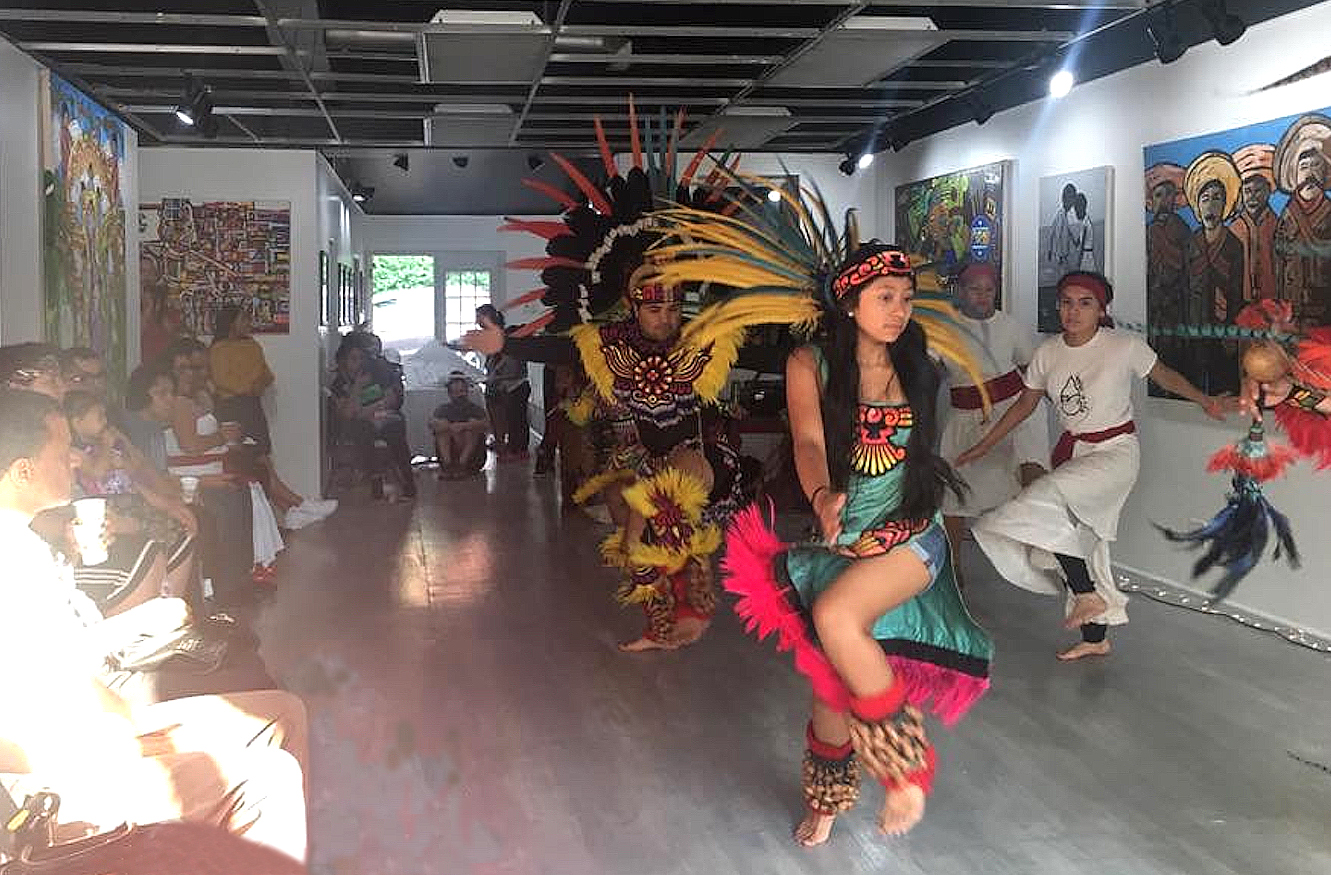
Youth performance at the Indigenous Roots Cultural Arts Center in St. Paul, Minnesota. Courtesy of Mary Anne Quiroz.
We have prepared an exciting opportunity for our 2020 tour at Indigenous Roots based in St. Paul, Minnesota. Established in 2007, Indigenous Roots (IR) is a community art organization dedicated to creating space and opportunities for indigenous people and people of color from different cultural backgrounds. IR facilitates workshops and events to promote holistic wellness through ancestral knowledge, art, and activism.
IR was founded by the married couple – Sergio Quiroz (Mexican immigrant) and Mary Anne Quiroz (Filipino immigrant) who both immigrated from their native countries to East Side St. Paul in 1989. In 2006, they first established a traditional Mexica/Aztec dance and drum group called Kalpulli Yaocenoxtli[1]. However, experiencing the strong need of culturally relevant platforms to further promote and practice the art of immigrant artists and artists of color, the dance project eventually evolved into a larger collective — Indigenous Roots[2]. IR began as a community of artists striving to meet the growing needs to re-connect as well as preserve ancestral knowledge systems—communities whose roots reach from Indigenous communities in Minnesota to Mexico, Asia, the Caribbean, and West Africa.
With the support of the community and years of hard work, IR opened its Cultural Arts Center in the Dayton’s Bluff neighborhood of East St. Paul in 2017. Hundreds of artists and community members donated their time and work to renovate the building, and have been carrying out numerous arts and cultural programming since its opening. The center became a bustling hub to various community arts organizations in partnership with IR. The front space of the center serves as a gallery for emerging artists, while the rear space is used for events, classes, and workshops. Kalpulli Yaocenoxtli dance classes, comedy nights with the Funny Asian Women Kollective and Blackout Improv, Hmong soup cook-offs, and coming-of-age ceremonies are just a few examples. The center also hosts social justice, creative place-making, and neighborhood revitalization events for the community.
After a stellar year of operation, unfortunately, like many other grassroots organizations, IR was affected by a financial crisis that had confronted the Dayton’s Bluff Community Council. In addition, IR faced displacement when a private developer wanted to purchase the property for commercial development. IR was on the verge of losing their space which was a result of the collective’s years of devotion. However, the community members did not sit still. The Twin Cities’ Local Initiatives Support Corporation (LISC)[3] who had heard about IR’s commitment to community work, strongly advocated for IR to the Land Bank Twin Cities, a community-based entity that specializes in assisting organizations with acquiring property. Miraculously, IR was provided with the funds from the Land Bank, which enabled IR to formally acquire the property from the previous owner. Along with the help of a small grant from LISC, IR was able to purchase the building over the next three years. Indigenous Roots Cultural Arts Center is a living token demonstrating the power of community collectivity. The Center continues to play a key role in the growth of grassroots through arts and activism in the rapidly changing cultural scene of the Dayton’s Bluff neighborhood, East St. Paul.
For those who are interested in culturally responsive pedagogy and identity work grounded in a non-western belief system, come join our tour to IR’s Cultural Arts Center. We will meet IR’s Co-Founders/Co-Directors Mary Anne and Sergio Quiroz and engage with interactive activities of dance and healing movement, creative place-making walking tour, and a community mural. For more information, please visit IR’s websites:
https://indigenous-roots.org/our-work
https://www.facebook.com/IndigeRootsCulturalArts
References
Olson, M. (2018). The blessing. Pollen. Retrieved from https://www.pollenmidwest.org/stories/the-blessing
Moritz, K. (2018). Indigenous Roots is claiming space for artists of color. Rewire. Retrieved from https://www.rewire.org/our-future/indigenous-roots-artists/
Moritz, K. (2016). Why youth take a stand at standing rock. Rewire in Twin Cities PBS. https://www.tpt.org/post/why-youth-take-a-stand-at-standing-rock/
Endnotes
[1] Kalpulli Yaocenoxtli means “warriors of the first cactus flower” In Nahuatl language.
[2] According to IR’s co-founder and co-director Mary Anne, the organization’s name “Indigenous Roots” was designated as a term to respectively honor our own heritages.
[3] Local Initiatives Support Corporation (LISC) is a national organization committed to finding equitable ways to Invest In the people, places, and projects that strengthen communities. As one of LISC’s local offices, LISC in the Twin Cities provides capital, strategy and know-how to Twin Cities community development partners. Retrieved from http://www.lisc.org/twin-cities
MAY 2015: Then and Now: A Photographic Journey Celebrating the Harlem Renaissance Centennial.
By Ayelet Danielle Aldouby, Social Practice Curator
Celebrating a community’s heritage with Artist Maren Hassinger and 7th graders from Teachers College Community School (TCCS).

“A glimpse of Harlem’s past, a light for Harlem’s future”[1]
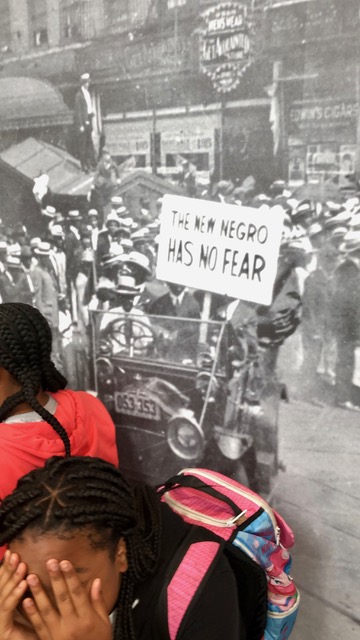
During the 1920’s and 1930’s Harlem’s artistic, musical, literary and intellectual flowering fostered a new black cultural identity. The multi-session art collaboration between Harlem-based artist Maren Hassinger and the 7th grade at TCCS was created on the occasion of Harlem’s centennial celebration.
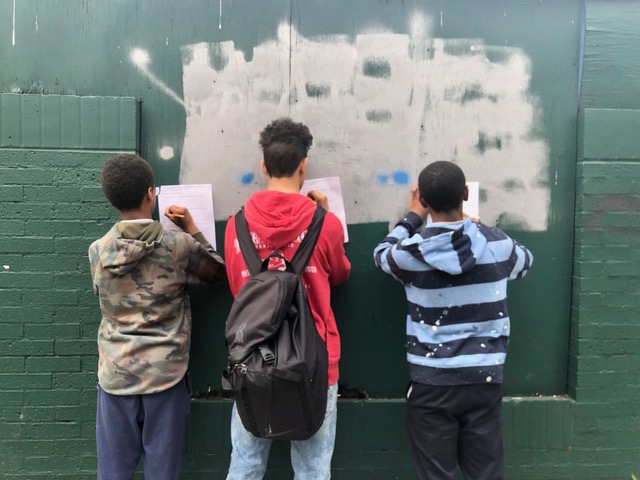
The photographic journey highlights Harlem’s historical past manifested through street scenes, churches and theaters. Archival photographs researched at the Schomburg Center for Research in Black Culture established a historical reference of time and place while students photographed the current sites to create a connection between the past and the present, reflecting on the differences and similarities.
“Looking at the past can help shed light on the present and inspire for the future. The project aims to envision places of learning beyond the classroom, carving a meaningful role for art education in students’ lives.”
– Maren Hassinger
The collaboration was initiated by social practice curator Ayelet Danielle Aldouby & the Art and Art education program, Teachers College, Columbia University. Special thanks to Brian Jones and Michael Mery at the Schomburg Center for Research in Black Culture, Katy Maiolatesi (TCCS Liaison) and Ann Lattner (Social Studies Teacher).
[1] “A Ballad for Harlem” exhibit, Schomburg Center for Research in Black Culture.


 Community Arts Caucus